Nine out of ten family office GL conversions need outside help to land properly. That’s InfoGrate’s track record — more than 100 implementations over 20 years, and in roughly 90% of them the team has had to step in: reorganising charts of accounts, untangling dimensions, pulling a stalled migration back on track. The Asseta conversion was the first one they watched from the sidelines.
It’s the lens Dr. Tania Neild brings into this conversation, and a useful frame for everything that follows. The session covers Asseta’s architecture in some depth: why they built from scratch, how unlimited dimensional flexibility makes partnership accounting possible without bolting it on, and what the Claude MCP unlocks in practice. Ryan, Asseta’s product lead, demos both live — dynamic cap table updates on contributions and distributions, and a cash forecasting artifact that maps private markets pacing schedules out 12 months.
Partnership accounting had to be native, not bolted on
Horizontal ERP platforms — NetSuite, Sage Intacct — serve healthcare, manufacturing, professional services, nonprofits. Family office is a small vertical inside financial services, itself a small slice of their business. When Dean Palmitar escalated partnership accounting at Sage Intacct, it went on the roadmap. He waited more than two years. When it still hadn’t shipped, he left and co-founded Asseta in January 2023 with a GL architected from day one for unlimited dimensionality and native partnership accounting. Asseta is now rolling it out to its first clients.
Multi-dimensionality is what other platforms skipped
QuickBooks is single-entity: one-dimensional. Some newer competitors add multi-entity: two-dimensional. NetSuite and Sage Intacct offer multiple dimensions but with seven pre-canned fields and limited customisation. Asseta’s approach is unlimited customisable dimensions where owners can own entities, trusts, and properties, with relationships between any of them — three second-generation family members each owning a third of a trust that owns five entities, one of which owns ten properties. That structural flexibility underpins partnership accounting, cap table tracking, side pockets, and the Addepar V4 bidirectional sync.
A $10B family moved off Archway and saw more in 45 days than they had before
Archway is 25-plus years old: owned by SEI, now owned by a private equity firm. Palmitar’s characterisation: expensive, difficult to implement, difficult to use, and a closed API architecture. One Asseta client — a $10 billion single family office — made the move. Forty-five days in, still mid-migration, they reported more visibility in Asseta than they had ever had in Archway.
MCP is in production — and clients are calling it a game-changer
The Asseta MCP (Model Context Protocol) is live. Its third iteration shipped the night before this session. It lets Claude read and write data from Asseta’s platform — any transaction history, any object with an API endpoint. Clients are building their own micro-apps and artifacts: doing categorisations, reconciliations, parsing statements, building and pushing draft journal entries. The session demo shows a cash-flow forecasting artifact: 12 months of historical spend used to project the next 12 months, layered with a private markets pacing schedule mapping capital call and distribution profiles for each fund in the portfolio.
Addepar V4 bidirectional sync closes a decade-long ask
The new Addepar integration goes both ways. Contributions and distributions recorded in Asseta automatically push cap table changes — updated ownership percentages — back to Addepar’s ownership tables. Co-developed with a multi-billion-dollar NYC single family office; four other billion-dollar-plus clients and five prospects are asking for the same. Addepar itself has been requesting the write integration for some time.
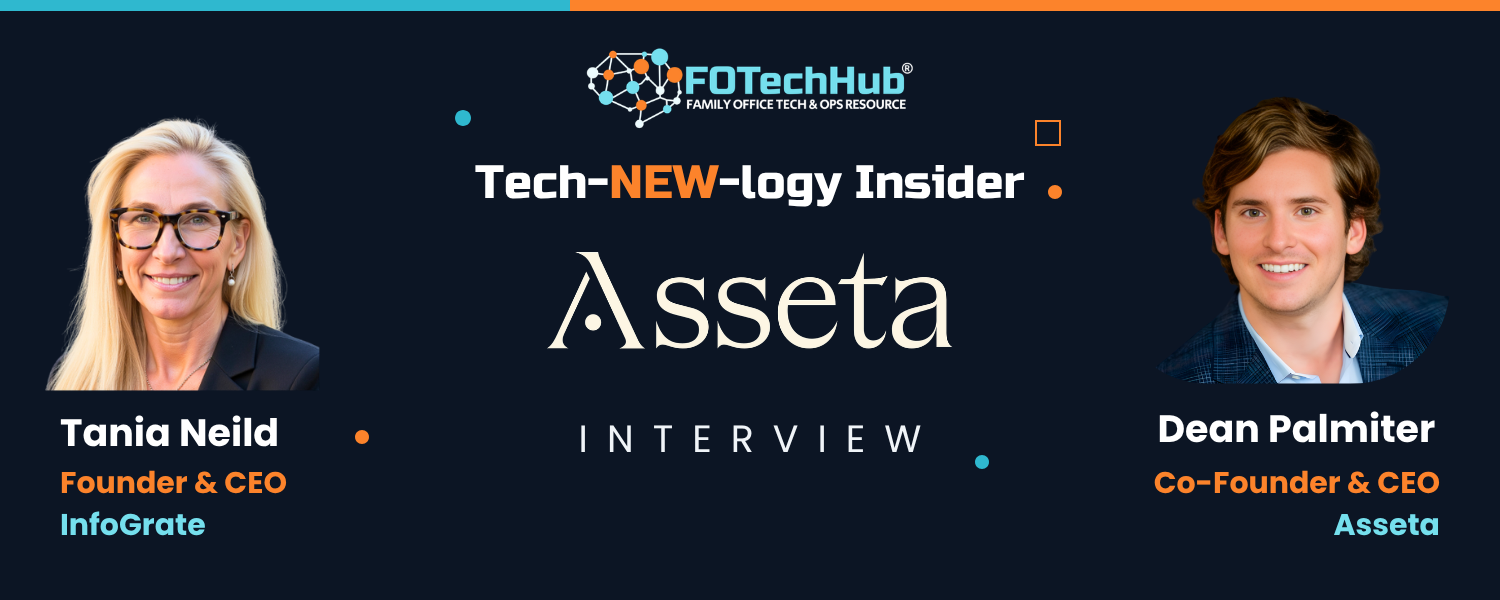
Dean Palmiter — CEO & Founder, Asseta
Ryan Tapley — Senior Solutions Architect, Asseta
Adriana Zalucka — FOTechHub · host
Transcript
Adriana: Welcome to today’s Technology Insider session — and for those of you who were with us yesterday, welcome back. The Technology Insider series is a founder interview series highlighting innovative technologies for family offices. Today on the agenda we have 45 minutes: about 30 minutes of interview, then a short look at what Asseta is bringing next, and then time for questions. Dean Palmitar from Asseta is our guest — he’s the CEO and founder. Asseta is a family office accounting platform that we see a lot of interest in and development from. Interviewing Dean is Dr. Tania Neild, our collaborator. She’s the CEO of InfoGrate, a specialist family office consultancy with deep background in family office data integration and accounting systems, and a keen eye on AI in this space. With that, over to you, Tania.
Tania: Thanks everybody, and thank you Dean for spending your Friday lunch period with us. If you have questions, go ahead and put them in the chat and I’ll try to weave them in. I think we’re going to try to hit four or five topics in 30–35 minutes. And we may have convinced Dean to do a little sneak peek at some of the new features — which feels a bit like seeing a grizzly bear on your Alaska trip. You’re just lucky if you get one.
The first thing I want to say — I have done, let’s call it 100 GL conversions over the course of the last 20-plus years. We’ve just recently completed an Asseta conversion, but I’ve completed many, many before it. And 90% of the time, my team and I have had to get involved and help with the conversion, because a lot of times the vendor doesn’t really understand how to streamline a chart of accounts or use dimensions properly. For the first time in 20 years, we did a project where Dean’s team was responsible for the implementation. And all we did was watch and enjoy the view. His team literally dug in and did it all. Extraordinarily impressive and very unique in this space.
And I think that goes to show the depth of understanding here — you have something like $110 billion and 50 family offices on the platform, and you’re just two years out. Most people would call that the terrible twos. This sounds like quite the phenomenal two-year-old. I know you’ve recently done a rebranding and are looking to expand from single family offices out to accounting firms, RIAs and so forth — tell me you’re not leaving the family office base.
Dean: No — leaving the family office space would be news to me. 90-plus percent of our customer base are single family offices. We serve the higher end of the market: the billion-dollar-plus segment. We have clients across the entire spectrum of wealth — our smallest client is $20 million, our largest is $20 billion. We have dozens around $200–500 million, 25 that are $1 billion-plus, and three or four who are $10 billion-plus. And I would estimate 95% of our customer base is single family offices. We do have a handful of multifamily offices — larger in terms of client base, some with a handful of billion-dollar families in them. We also see interest from larger RIAs and from private banks. We have two top-25 CPA firms on the platform today, both with a very heavy presence in the ultra-high-net-worth and family office segment.
Tania: So signaling that you’re prepared to scale — the big, the small, and the multi.
Dean: We have functionality that multifamily offices and CPA firms genuinely appreciate — highly differentiated from something like Sage Intacct or NetSuite. But we’re focused on the $500 million-plus. That’s who we’re building for. That’s the segment we focus on.
Tania: Let’s move to partnership accounting, which seems to underline your ability to handle the complexities of even a $20 billion family. Why do you think partnership accounting has stayed so unsolved in this category?
Dean: So we’re coming up on two years in market, but we’ve been around for almost four years. We founded the company in January 2023, put our first customer on the platform in December 2024. But I’ve been helping family offices with GL conversions for over 10 years. I started my career at NetSuite before the Oracle acquisition, on the financial services team. I left to join Sage Intacct to build out their financial services vertical. While I was at Sage Intacct, I helped convert over 70 single family offices to that platform. And one of the biggest things that kept coming up was how we handle — or don’t handle — partnership accounting.
I escalated this with marketing, product, and sales leadership: if we had partnership accounting, we could go up-market and be selling six-figure contracts. They listened, and product put partnership accounting on the roadmap. And I waited over two years. It never came.
And so literally my experience at NetSuite and Sage Intacct — implementing ERP software for family offices — led me to start my own GL company from scratch. Which is a daunting, terrifying task: starting a software company and trying to compete with Oracle and Sage just seemed kind of crazy. But we started building. The first thing I told my co-founder and CTO Daniel was: we’re going to rebuild accounting software from scratch. It has to be multi-entity, multi-dimensional, scalable internationally, and it has to support partnership accounting natively. We’ve been thinking about partnership accounting since the very beginning when we were architecting the GL. We’re just starting to roll it out to a handful of clients — but it’s something we’ve been working towards for four years.
The robust dimensionality and architecture of the general ledger is what’s going to enable us to bring partnership accounting to this underserved market. We really only see maybe two other platforms that offer partnership accounting, and we believe it will be very clear in short order that Asseta’s is the most well thought-through and well-architected.
Tania: So why has the market not responded historically — Sage Intacct, NetSuite, QuickBooks? Why is it so hard? And what did you put in from the start that makes it work?
Dean: NetSuite and Sage Intacct are horizontal ERP solutions — they can be used across all industries, companies of all shapes and sizes: healthcare, manufacturing, professional services, nonprofits, software companies. We only focus on family offices. When I joined Sage Intacct, financial services was the smallest but fastest-growing vertical, and I was employee number two on that team. Family office is just a small vertical within financial services, which itself is a small piece of those large companies. Partnership accounting in the family office vertical is very misunderstood by their investors and leadership. How many family offices are there? Where do you find them? How do you market to them? Pitching venture capitalists on a very narrowly defined market is tough.
There are AI accounting software companies from the last four years who have raised over $100 million — more than two or three of them — and they’re focused on bigger markets like software and professional services. We took the harder path, focused on the key functionalities family offices actually care about, and stayed true to this smaller market because we knew QuickBooks, Sage, and Archway aren’t cutting it. There’s an opportunity here.
Tania: And what’s in your structure from the start that facilitates that?
Dean: It’s the concept of customisable and unlimited reporting dimensionality. QuickBooks I refer to as single-dimensional — single entity. There’s another startup in the space with multi-entity functionality — I call that two-dimensional. Then there’s three-dimensional: multi-entity and multi-dimensional. Sage Intacct and NetSuite are multi-dimensional, but their dimensions are pre-canned — vendor, item, class, entity, employee, customer. Seven standard dimensions, plus you can add maybe three custom ones that require heavy implementation work.
We take a completely different approach. Owners can own entities, trusts, properties — and creating relationships between different dimensions is what makes it powerful. You could have three second-generation kids who each own a third of a trust. The trust owns five entities. One of those entities owns ten properties.
Tania: So you can do side pockets too?
Dean: Yes — and Ryan will be on to talk more about that. The relationship between the dimensionality and the flexibility to create those structures is what makes it work.
Tania: I’ve had to teach people for years that “item” means investment in other systems. It would be wonderful not to have to memorise that. Does this mean trust accounting might be on the horizon?
Dean: I was asked that question yesterday and to be honest, I’d love to learn more about what that means specifically to people. I don’t want to say we have trust accounting without knowing the nuances. But I don’t see why we wouldn’t be able to — the way we’ve architected the GL, we have the scalability and flexibility to go into really anything. Ryan, who started in public accounting and then joined a large multifamily office in Canada and then worked with the Ford family out of Detroit — he’s a CPA and CFA — Ryan, could we eventually do trust accounting? What’s stopping us?
Ryan: Nothing. It’s that creativity around dimensional use cases — you can have your chart of accounts structure built out and then use two dimensions, for example: principal versus income. You’re diarising all your transactions into one of those two categories while still preserving the integrity of the chart of accounts. That’s certainly a way to manage the minutiae of trust accounting using the creativity of those dimensions.
Tania: All right. I think probably the reason Adriana dropped Ryan in is that while we’re talking about partnership accounting, we’re going to get a little sneak peek.
Adriana: Yes — and we also have a question on Archway, so let’s pick that up.
Tania: I wasn’t going to put you on the spot with a full vendor comparison, but Archway is a well-known system in this space for handling partnership accounting and complexity. Could you say a word or two about how you’re thinking about that?
Dean: I can only go on what people tell me. We have clients who’ve moved off Archway onto Asseta. Within 45 days of implementation, a $10 billion family who was on Archway told me they had more visibility in Asseta halfway through the migration than they ever had in Archway. I think that speaks volumes.
My read on Archway: they’re 25-plus years old, owned by SEI, neglected by SEI, now bought by a private equity firm that’s brought in a sponsored C-suite. I know it’s expensive. I know it’s difficult to implement. I know it’s difficult to use. They do have partnership accounting from what I understand, which is a big plus for them. But I’ve learned they’re not particularly open — I don’t know that they have an open API architecture the way we do.
Tania: Well, they’re a robust accounting system. But your dimensions — from the second I met you, the pivot capabilities, the ability to slice and dice, move rows to columns and columns to rows, multiple levels of drill-down — that was one of the things that drew me to the system immediately. Let’s talk about mobile and MCP, which I think is also in beta?
Dean: The MCP is in the hands of several customers testing it — we pushed out a third iteration last night. But partnership accounting, the mobile app, more robust permissions and approval workflows, the Addepar V4 integration, our bill pay module — those are the priorities and the key differentiating new modules from the last couple of quarters.
When I think about Asseta’s roadmap, the question I ask is: what have family offices been asking for for 10-plus years that they don’t have yet? One of those things is a mobile app — a dashboard for net worth at a glance, real-time cash balances, notifications where the principal can approve a bill while they’re travelling. That’s what we offer today. And it works particularly well for principals who are away: the CFO or controller back at the office needs to get their attention, the principal gets a notification on their phone.
And then there’s granular user permissioning — you can lock a user down to exactly what you want. Read and write access across different modules, across different entities, across different accounts on the chart of accounts.
Tania: So if I have a manager approving bills for an estate, can I give them the mobile app and have them see only what they need to approve?
Dean: Yes — and permissions apply to the web app too, not just mobile. One of our clients has 25 accountants at Baker Tilly using the platform. They’re very particular about who has access to which entities, which chart of accounts items, which workflows. Any action in the system gets logged in audit tables — who was in the system, what they viewed, what changes they made, the prior and new values, when it happened.
Tania: Are you seeing mobile adoption? I know this has historically been a change management challenge — family members often say they want a dashboard but never log in unless they have to take action.
Dean: We have to remind people we have a mobile app. The market has been asking for it, but we do have to make sure people download it and know how to use it. The people who have been asking for it and have downloaded it are using it. But to your point, not everybody actually wants to log in. People might say they want a dashboard and a report snapshot — and then ultimately want their reports printed or in Excel. So it’s either they love the dashboards on mobile, or they’re never going to log in. We see both.
Tania: You mentioned Addepar V4. Can you speak to what’s in V4 versus V3, and are there plans for integrations with estate management systems like NINES or Eleven?
Dean: We know the NINES team. We do have our own collections module — valuations, insurance data, and more — for clients with a large portion of net worth in illiquid hard-to-value assets: cars, art, collectibles, stamps, wine. We could integrate with NINES or Eleven if we had enough clients asking. And frankly, any application that has an MCP can integrate with Asseta now.
On Addepar V4 — our mutual client, a multi-billion-dollar single family office in New York, asked for the ability to have cap table ownership automatically updated in Addepar based on contributions and distributions in Asseta. So V4 will have the ability to automate the cap table changes in Addepar based on activity in Asseta.
Tania: So you’re pushing into Addepar’s ownership tables? I’ve been asking Addepar for an easier way to keep managed funds and ownership current for about ten years. It sounds like you may be the answer.
Ryan: As I understand it, we’re pushing to their ownership tables as the primary use case — but that’s not to say we couldn’t push to other aspects of their application.
Tania: So it’s a bidirectional sync?
Dean: It will be. We’re co-developing it with that New York family office. There are four other billion-dollar-plus Asseta clients asking for it, and probably five prospects asking for it before they’re even customers. Addepar has been asking us for a long time whether we could push data into their system. We said sure — you tell us what you want. They had ideas, we pressure-tested them against the market, and figured out that the initial use case is partnership accounting and ownership tables.
Tania: Phenomenal. And other integrations?
Dean: RAMP, bill.com, Expensify, Arch. We’re building an integration with iPaladin. For clients who have Addepar, we advise using that built integration — Addepar and Arch have over 100 mutual customers. But for those who don’t have Addepar, they’ll be able to link directly to Arch and pull in capital calls and distributions, create journal entry rules, and book them to the ledger.
Tania: I’ll add — I always tell clients that going directly from Arch into the GL is a preferred option because you often have more detail on the capital call than you might need for performance reporting in another system. And did I hear you’re integrated to Black Diamond as well?
Dean: Yes. We have two clients using that integration. I don’t know of any other accounting software that integrates with Black Diamond, but we can and we do. We actually built that integration before we built the Addepar integration.
Tania: Let’s talk AI. You’ve come out with an MCP — tell us the status, and where else are you leveraging AI within the system? And I know clients will ask about guardrails.
Dean: Our MCP is in production and has been rolled out to several clients. A couple of them have called it a game-changer. We’re an interoperable system of records. For those who don’t know, Model Context Protocol is a version of APIs specifically built for LLMs — so our MCP allows you to connect to Claude and read or write data from Asseta. Any transaction history, any object in the platform that has API endpoints, the MCP can pull on those endpoints to surface insights. We know of clients who are building their own micro-apps, skills, and artifacts in Claude — doing categorisations, reconciliations, ingesting documents, parsing and normalising data, building journal entries, and pushing them into Asseta.
Tania: A couple of my clients haven’t taken the leap to Claude and are staying within Microsoft Copilot. Are you working on an MCP for Copilot?
Dean: Our MCP is interoperable to other LLMs — so it may just be a configuration. Happy to work through that with any client who’s passionate about Copilot or ChatGPT. We’re not pushing AI on people. They ask for it, they opt in, they connect the MCP to their own Claude instance. For family office professionals already approved to use Claude Enterprise, they can connect Asseta to their instance. On permissions: Asseta has very robust user permissioning. Claude does too. The combination of both can ensure you’re not pulling data or writing to the system in ways you’re not allowed to.
Tania: Can we get a sneak peek?
Ryan: Sure. I’ll touch on two things — partnership accounting and then the MCP. Partnership accounting lives in our ownership module. I’ve got about a six-layer ownership structure in this environment. What the latest iteration of our partnership accounting module allows is dynamic updates to ownership percentages based on transactions — contributions and interactions with the partnership — whether pro-rata or disproportionate.
So here I’ve got a partnership, Two Rivers Ranch, with two entities in a roughly 90-10 split. If I want to transact at the partnership level, I click into Two Rivers Ranch and see high-level details: the ownership, the partnership structure, who the owners are today, any activity that’s transpired. I can go to the entity hub for more detail and then record a capital event — a contribution or a distribution. Say I want to do a $10 million contribution today. I can choose to do that pro-rata based on the 90-10 split, which won’t change the ownership percentage. Or I can select just one entity — say all $10 million coming in from the 2024 grant — and that dynamically updates the ownership percentage at the bottom based on the prevailing economics of the partnership: total equity value as of the transaction date.
Tania: And do you treat side pockets as an entity under an entity with a particular type?
Ryan: We can do that. Right now we’re operating on a single-sleeve approach — one general economic sleeve within the partnership. We’re working on a multi-sleeve approach, which allows you to say these assets are sleeve A and these are sleeve B — that side pocket deal, a continuation vehicle, or similar. So you can run multiple economic partnerships within the same partnership structure. That’s the next iteration.
Tania: Waterfall calculations are the one area where I say the “when you’ve seen one family office, you’ve seen one family office” rule actually holds. That’s probably a wonderful opportunity to combine the MCP with your partnership accounting.
Ryan: Exactly. And the multi-sleeve approach is where we’ll be able to turn on a profit-interest waterfall arrangement with a GP, or whatever the structure may be. We’re also seeing more family offices looking at lender management structures, which ties nicely into our ability to service those partnerships with the multi-sleeve approach.
Now let me quickly show the cap table view before we move to the MCP. So once I’ve pushed a transaction through, I can see the cap table for Two Rivers Ranch. What we’re doing is crystallising the ownership percentages over time — so if you look back at any given period, say December 31, 2025, and run a balance sheet or income statement, it reflects the true economic reality at that point in time, even if ownership changed subsequently. That historical integrity is what the cap table crystallisation preserves.
Ryan: And now the MCP. We can push and pull data to and from Asseta via the MCP. Right now I’m pulling data in — I’ve built an artifact that takes your historical 12-month spend in Asseta, real dollars in and out of your entities, and applies AI to forecast that over the next 12 months. You get a sense of where your cash is today versus where the projection is headed.
More importantly — and this is something a lot of our customers have been asking for — is the private markets pacing schedule. Pulling in all your various fund obligations, mapping them out over time, estimating the life of each fund, the investment period, and using the IRR to dictate the capital distribution and contribution profile. Forecasting that cash over the subsequent 12–24 months is a real problem in the family office space. That’s an example of pulling data. On the push side: if you have a private markets statement that isn’t directly integrated yet, you can drop in the statement or trial balance, have that data pulled and then pushed to Asseta via draft journal entries.
Adriana: Ryan, let’s save the rest for the conference demo and the deep dive afterwards. You certainly have enough to talk about.
Dean: Yes — we’re doing a conference demo of about 15–20 minutes and then a deep dive with the FOTechHub team of around an hour. Do participate in that.
Adriana: Thank you Ryan — great readiness. Thank you Dean and Tania. With your permission we’ll take today’s demo and put it in our demo library, so our audience can go back and look at what’s of most interest to them. Thank you to everyone who joined and asked questions. We’ll be back with the next one.