Eleven Systems spent a decade developing and refining a family office operating system for its own single-family office before making the software available to other families and their advisors. This podcast tells the story of how it all came together.
Before founding Eleven Systems, Austin Lowery ran Jetson Systems, a home automation small business serving ultra-high-net-worth clients. He programmed touchscreens that controlled cameras, access systems, security, distributed audio and video, and other connected residential technologies.
One of his clients, Salesforce CEO Marc Benioff, offered advice that helped spark the idea for Eleven Property. Austin then partnered with the owner of Eleven Experience, a commercial hospitality business, to develop a comprehensive property management solution.
That partnership grew as Austin addressed additional challenges for the same client, who also operated his own family offices. He developed Eleven Financial, followed by Eleven Family – solving one challenge at a time and ultimately building an integrated family office operating system.
Five takeawaysThe idea came from a corner office in San Francisco
Lowery was servicing a property for Marc Benioff when Benioff sat him down and told him what the product should actually be: put it in the cloud, let the owner see every home’s cameras, door access, and security from a web browser, load in all the assets, tag insurance policies, flag the fridge before arrival. Lowery walked out unable to shake the idea. He brought it to a client who said yes before he finished the pitch.
Property is the module families always need but rarely have covered
Families may already have Addepar for reporting or Archway for bill pay — tools they’ve invested in and won’t replace. Property is different: competing solutions exist, but most families don’t already have one running. No switching cost, no integration conflict. That’s what makes it the land-and-expand entry point — Eleven earns trust without asking anyone to displace something they’re already using, then the conversation about financial and family modules opens from there.
$300 million that didn’t exist until the software found it
The founding client’s properties — art, vehicles, boats, fixtures, the buildings themselves — were not on his balance sheet. Once Eleven Property was running, every asset was tagged with appraisal values and insurance policies and rolled into the financial dashboard. The total that surfaced: roughly $300 million that had never been allocated to his net worth.
AI built around the permission layer, not on top of it
Most platforms add an AI chat interface to existing data. Eleven structured the data first for permissioned access, then layered agents that each do one specific task within their permission boundary. A single omniscient agent that aggregates across the whole platform is a liability; a single-task agent with a constrained data view is near-zero risk. The platform is SOC 2 and SOC for Cybersecurity certified, and has passed InfoSec audits from major banks.
“Service as a software” — the team is part of the product
Lowery’s line is a deliberate inversion of SaaS. The software is enterprise-grade and nobody deploys it alone. Eleven runs a full property onboarding team that can get a large estate live within days: loading vendors, training house managers, setting checklists and issue-tracking standards. For advisors who want it, they’ll white-label the whole thing.
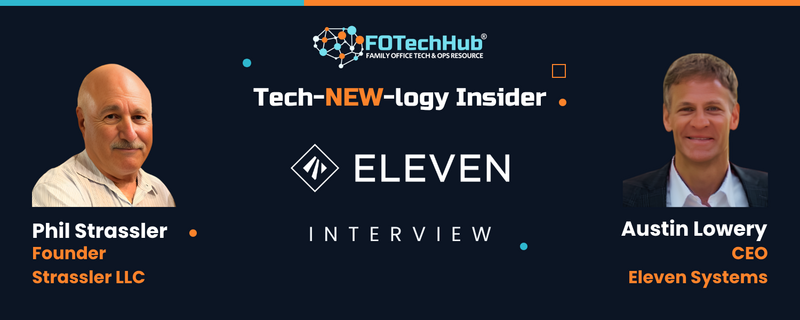
Austin Lowery — Founder & CEO, Eleven Systems
Adriana Zalucka — FOTechHub · host
Transcript
TRANSCRIPT
Eleven Systems — Tech-NEW-logy Insider
Phil Strassler with Austin Lowery · Adriana Zalucka, host
ADRIANA
Welcome everybody. I’m Adriana with FOTechHub, and today we are back with our Technology Insider series after a summer break. The Technology Insider is an interview series with founders of tech companies and tech solutions, highlighting the ones you should have on your radar.
Today we have Austin Lowery, CEO of Eleven Systems. Eleven Systems is a family office platform with three modules — property, financial and family — with AI running across all three. Austin is telling the story behind Eleven for the first time: how he went from designing control systems for high-end residences to building an operating system for family offices, originally for one client with a global property portfolio.
We also have Phil Strassler, who most of you already know well. Phil has advised family offices on tax operations and a wide range of issues over many years and is a longtime collaborator of ours. Phil is normally behind the scenes, but today he’s interviewing Austin himself.
Over to you, Phil.
PHIL STRASSLER
Thank you, Adriana. This is a real privilege — I think we’re going to cover something truly on the cutting edge. Austin, let’s start with the basics: what does the Eleven platform do for family offices?
AUSTIN LOWERY
The Eleven platform includes three applications: financial, property, and family. It was built over time for our own single family office to address the specific challenges we were having. It started with Eleven Property, and we kept building from there as we added features and improved the platform.
PHIL STRASSLER
Property first.
AUSTIN LOWERY
Yes. It started back when I had a tech firm doing home automation and control systems. One of our clients — who is now the founder and principal of our family office — had a number of properties we were building home control systems for. He acquired my company, Jetson Systems, brought it in-house, and we set out to build technology to solve the challenges he was having across his portfolio. He currently has 86 properties worldwide.
PHIL STRASSLER
How long ago was that?
AUSTIN LOWERY
Twelve years ago. Time flies. We’ve been building throughout that period — not because it took that long to build, but because we were rolling it out across the family office and its various businesses. The people using it gave us feedback, which helped us iterate and improve. It’s a very mature and stable platform that’s been in active use for a decade. We’ve now begun commercialising it and rolling it out to other families.
PHIL STRASSLER
What are the key differences between residential and commercial property management that you had to work through?
AUSTIN LOWERY
We never set out to build a commercial solution. We do run the platform for Eleven Experience, which is a commercial hospitality business — but it operates out of high-end residential properties. So the application is built specifically for high-end residential homes.
PHIL STRASSLER
Walk us through what makes it special.
AUSTIN LOWERY
Happy to. We started with Jetson Systems installing home automation in high-end residential homes — touch screens controlling audio, video, security cameras, door access, distributed audio, music libraries. This was before the iPhone launched, so for high-end clients with large estates, it was a genuinely new experience.
The idea for where to take it came from one of our clients, Marc Benioff, CEO of Salesforce. I was working at his home in San Francisco and he said he’d never had a system so easy to control, but he’d had nothing but problems with his property in Hawaii and asked if I’d go and audit it. He flew me out, I stayed at the property, did the audit, came back, and he sat me down in his corner office.
He was very generous with his time. One of the key pieces of advice he gave me was: put this in the cloud. Make it readily accessible to everyone. He said he should be able to pull up any of his homes right now and see the cameras, the door access, the security and the lights, all from a web browser. And beyond that — load in all the assets, tag the financial values and insurance policies, and make sure the property is always ready: fridge stocked, staff briefed to a standard.
I walked out of that office unable to shake the idea. I brought it to the client who is now our principal, because he had a large real estate portfolio — over 80 properties. He’d started the real estate practice at the Blackstone Group and was heavily invested in real estate. I barely finished pitching before he said: let’s do it, I’ll fund it. He acquired Jetson Systems and we began building.
What makes the platform valuable is that it started with the cameras, door access, lights, and climate, and has grown to integrate with back-end general ledger systems so you can pull in your CapEx and OpEx spending, layer budgets on top, and understand exactly what your landscaping bill is and why it’s high. Your team on the ground can manage costs in real time. Your staff has the tools to ensure the property is always ready. When there are issues, the principal sees them in the dashboard before he arrives — no more surprises, and he can see his team is on top of it.
And then the financial layer: all the assets in the property — art, vehicles, boats, anything valuable — are tagged with appraisals and insurance policies and can roll into any general ledger or financial reporting tool. We have our own Eleven Financial, but we also support integration into other reporting tools. For our principal, this revealed roughly $300 million in assets that had never previously been allocated to his net worth.
Now, with AI natively embedded, we have agents that act as a virtual property assistant. What wine do I have that’s ready to drink? What issues exist at the property? When is my vehicle registration due? What is my landscaping bill? All of that through an AI agent, instantly.
PHIL STRASSLER
How do the AI agents work across different clients — how is each client kept separate?
AUSTIN LOWERY
Great question. As the saying goes, if you know one family office, you know one family office. Every family is different. They work differently and they use different tools. We learned early that we had to support whatever tools those families already use, and that we needed flexible onboarding.
In straightforward cases, a family is well organised — they have a Dropbox or Google Drive folder — and it’s simply a matter of connecting that folder to our data hub, which ingests the documentation. What took ten years to build was the underlying data structure: a carefully designed database of everything that should be organised in a family office and in a property. So when an insurance document comes in, the AI knows how to read it, what to extract, where to file it, and what to surface in the dashboard.
We also have to support the legacy tools families love and want to keep using. Over time, some migrate over to our platform, but we never force it.
PHIL STRASSLER
Give us an example of a messy onboarding — a client who came to you in complete disorganisation.
AUSTIN LOWERY
We had a client who had just finished a pool house renovation and handed us a legal box of receipts and documents. What sounds like a monumental task is exactly where AI becomes powerful. We had it scanned by a service provider, provided to us digitally, and the AI parsed it. Around 85–90% of that information was automatically filed and categorised into the platform. The structure we have in place means the AI knows where everything goes, what to surface, and how to present it.
We had one client say they’d never understood their insurance policy until they saw it in our platform. It was suddenly clear — and available on their iPhone and in their browser, always with them.
ADRIANA
A question from Gary: is this software, or is it generative AI, and how are the agents built inside the system?
AUSTIN LOWERY
We call it Eleven AI. It’s an orchestration layer that leverages specific agents within the platform, each doing a defined task. It’s not an open door — you can’t just ask anything. Access is strictly tied to permissions. Every part of the platform is permissioned: you can see certain properties, certain assets, certain financial values or not. Some house staff can only see checklists and issue tracking.
The orchestration layer is model-agnostic — you can bring your own model or your own enterprise licence. But our primary goal is privacy and data security, and that’s what the orchestration layer is built around.
PHIL STRASSLER
Give us the overview of the whole system — how property led into everything else.
AUSTIN LOWERY
It’s a good story, and it’s one where we started building without realising we were building a family office operating system.
It started with property. From there, our principal said: this has completely organised the properties, ensured readiness, inventoried all the assets — can you do the same for my financials? He was getting a monthly report from his Merrill Lynch advisor, and by the time he received it, it was already out of date. He couldn’t make real-time decisions.
So we built the financial layer. His private investments had been tracked in spreadsheets, and we weren’t going to ask his team to abandon those — so we supported the spreadsheet data and augmented it by connecting to data feeds. We integrated into the back-end accounting system so we could track budget actuals for both operating and non-operating businesses. All of that rolls into a dashboard where you see every asset at the top level and can drill down all the way to the individual asset data card — a rich object containing all information about the asset, its files, notes, contacts, and a private messaging thread. Every action in the platform leaves an audit trail.
Then came the family layer: philanthropic endeavours, estate planning — which AI can now build automatically from forwarded trust documents, parsing them and populating data cards for each trust, rolling up to the estate plan with ownership structures and scenarios. Travel tracking and residency reporting too. Our principal needed to track his travel carefully to maintain US residency over UK, and within the US, Florida over New York. We set up those rules. His assistant forwards travel receipts and flight records; the system classifies personal versus business travel, kicks off capitalisation reports to the accounting team, and generates IRS reports. When we were audited, we produced a 450-page PDF with every receipt, hotel bill, and GPS record. Case closed.
All family member documents — passports, licences, visas, memberships, birth certificates — are organised in the platform, always accessible when you need them.
PHIL STRASSLER
Why do you lead with property? Who are you talking to when you onboard a family?
AUSTIN LOWERY
Property is consistently the most needed solution. When we talk to families, it’s what everyone gravitates towards immediately. And there’s rarely a competing tool already in place — a family might have Addepar for reporting and we can integrate with that, rolling property asset values into their Addepar reports. But for property management itself, we’re usually not displacing anything.
We’re typically talking to the operations team, and the COO is usually the decision maker. Eleven Property is our land-and-expand entry point. Some families want the full platform from day one; others start with property alone. We scale pricing accordingly — starting low and adjusting based on asset size, complexity and need. It’s choose your own adventure. We’ve had clients who started with just property come back six months later wanting to replace Addepar entirely, because the breadth and detail of what we provide goes well beyond what they were tracking before.
PHIL STRASSLER
A question from Gary: do you replace or sit on top of NINES, ORCA, Luminary, or Addepar?
AUSTIN LOWERY
For property, NINES is a direct competitor. I think NINES is a great solution, but ours is more robust on CapEx and OpEx reporting, accounting integration, rolling financial assets into a general ledger balance sheet, and systems integration — the ability to monitor cameras, door access, and security systems, and remotely reboot frozen devices over PoE switches. We wouldn’t integrate with NINES; it’s one or the other. For financial reporting, you’d either use us or Addepar — though we have integrated with Addepar for clients who want to keep it.
PHIL STRASSLER
So the natural progression was: you proved the value in property, clients asked for more, and you built out from there rather than trying to sell the whole platform upfront.
AUSTIN LOWERY
Exactly. When we first started selling, we led with the full platform — because who wouldn’t want all of this? But we found we were overwhelming clients. The platform is wide and deep, and it can be a lot to take in. We found more success leading with property. It’s concrete, easy to grasp, and you can see the immediate impact. Our property onboarding team — from our Eleven Experience operation — can get a large estate up and running within days. Once we’ve earned trust there, the conversation about the rest opens naturally.
PHIL STRASSLER
What about bill pay?
AUSTIN LOWERY
We’re not a bill pay solution, but we integrate around it. The family forwards an invoice into the AI; it creates a message that goes to the appropriate approver. Once approved, it integrates with bill.com. For clients using Archway for bill pay, we layer on top of Archway — pulling in general ledger codes and actuals, running budgeting on top, and queuing the approved bills for the AR/AP team at Archway to pay.
PHIL STRASSLER
What about historical data when onboarding from another system?
AUSTIN LOWERY
If they can extract the data from their old system, we can pull it into ours. For alternative investments, we’ve worked with Bridge, which can act as an agent — logging into a client’s portal and retrieving historical data. We then ingest all of that.
PHIL STRASSLER
How do you ensure the data is reconciled and final?
AUSTIN LOWERY
We use a shadow accounting provider — SRL, based in the UK — who cross-checks every transaction. Data feeds can also break, and there are timing issues: sell a security at Merrill Lynch and there’s typically a two-day holding period before it settles to cash.
To mitigate this, we built a net worth mover chart on the Eleven Financial dashboard. You choose your reporting frequency — daily, every two days, weekly — and you can see exactly how your net worth has moved, which line items on your balance sheet changed, and why. You can drill in and get answers. It’s eliminated a lot of phone calls — we joke internally that it put an end to the WTF emails.
PHIL STRASSLER
Where are your data inputs coming from — public securities, private securities?
AUSTIN LOWERY
Wherever we can get a digital data feed, we use it. For custodial data, we use aggregators — we’re integrated with both Plaid and Quiltt. For banks those don’t cover, we write our own integration. And for banks without API capability, we pull a daily CSV from a secure FTP folder. We have a whole team that handles that — it’s an old method, but it works.
PHIL STRASSLER
One of the biggest differences here sounds like the AI isn’t bolted on — it was designed in from the start.
AUSTIN LOWERY
It had to be. Security is too critical. You can’t have AI agents roaming across unstructured data. The data had to be structured first, with permissions and access rights built in. Agents then operate within those boundaries, each doing one specific job. There’s no single agent aggregating information from across the platform — because if that agent were ever compromised, the exposure would be significant. With single-task agents operating in their own permission boundary, the risk from any individual leak is near zero.
On security specifically: we undergo SOC 2 and SOC for Cybersecurity audits annually, external and internal application penetration tests, and regular audits of our data security models. We have a dedicated team working continuously with external vendors on data security and privacy. We’ve also passed InfoSec audits from major banks. We believe the platform is watertight.
PHIL STRASSLER
Who is getting the most value from the platform — single family offices, multi-family offices?
AUSTIN LOWERY
We’re finding strong interest from advisors, consultants, MFOs, and RIAs. The platform gives them a Swiss Army knife of tools for clients who have gaps — and a differentiated way to reach and serve those clients. In some cases, advisors make the introduction and we work directly with the family. In others, they go deeper and white-label the solution entirely — the family logs in and sees the advisor’s brand, not ours.
PHIL STRASSLER
So in one model the advisor owns the relationship, in the other the family does.
AUSTIN LOWERY
Exactly. When advisors want to be the service provider to the family, white-labelling makes sense — they’re putting their name on it and offering it as their solution. In other cases — particularly with property — some advisors won’t touch it and simply refer clients to us directly.
PHIL STRASSLER
What does the service side look like? How does training and onboarding work?
AUSTIN LOWERY
It varies. We’ve learned we have to be able to provide a turnkey solution. We call it service as a software — our joke at the expense of SaaS. The software is enterprise-grade, and somebody has to get it deployed properly.
We have a large team at Eleven Experience — see 11experience.com — and that team can come in and do as much or as little as the client needs. We can train an existing property manager. We can come in, find and contract local vendors in Palm Beach or wherever the property is, load them onto the platform, and set the property standard through the checklist and issue tracking tools. We’re flexible.
ADRIANA
A couple of quick questions before we close: does Eleven calculate investment performance, and how do you price for RIAs? There was also a question on ORCA and entity charts.
AUSTIN LOWERY
Happy to follow up on all of those by email, or we can set up a specific demo to walk through whatever someone wants to see.
ADRIANA
Perfect. And I’ll point out that we have demo recordings with Eleven on FOTechHub.com. Austin will also be demoing Eleven at our annual conference on 18–19 November — mark your calendars. We’ll follow up with everyone who asked questions today, and if anyone would like an introduction to Austin or Phil, just ask.
PHIL STRASSLER
In closing — if you have a problem you’re trying to solve, Austin is the right person to talk to. The way this business evolved was: solve a problem, then solve the next one. They’ve either already built the solution or they’ll tell you what to think about.
AUSTIN LOWERY
That’s exactly right, Phil. Thanks for saying that.
ADRIANA
Thanks everyone for joining. Thank you to Austin, to Phil, and to Chris for helping field questions. See you soon.